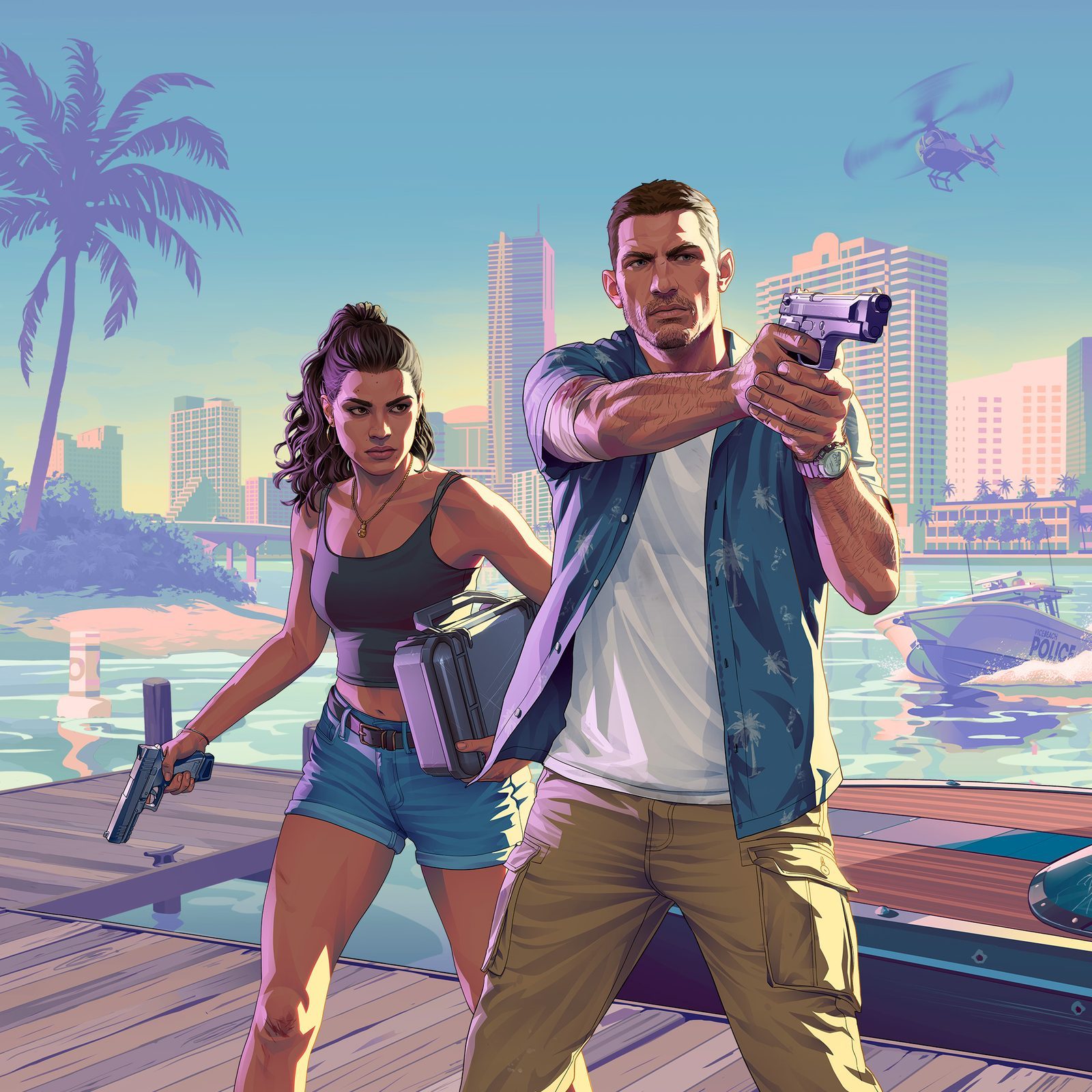
Quick Answer: Across nearly every meaningful system, GTA 6 is a generational leap over GTA 5 — built on 13 more years of engine development, a full console generation of hardware, and Rockstar’s hard-won lessons from GTA Online and Red Dead Redemption 2. The biggest shifts: a romance-driven dual-protagonist structure, a vastly larger and denser Leonida map, a clothing-based wanted system, far more enterable interiors, and a separately-launched multiplayer.
Why This Comparison Matters
GTA 5 launched in 2013 — a lifetime ago in game development. In the 13 years since, Rockstar shipped Red Dead Redemption 2 (2018), ran GTA Online as a live platform for over a decade, and watched open-world design evolve across the entire industry. GTA 6 is the first single-player Rockstar game since RDR2, and the first GTA built from the ground up for current-generation hardware. Comparing the two is really comparing two different eras of what an open world can be.
Headline Comparison
| System | GTA 5 (2013) | GTA 6 (2026) | The leap |
|---|---|---|---|
| Protagonists | Michael, Franklin, Trevor (business trio) | Lucia & Jason (romantic couple) | Emotional stakes replace transactional ones |
| Setting | Los Santos, San Andreas | Leonida (Vice City + state) | A whole state vs. a city-plus-hinterland |
| Map scale | Large; lots of empty desert | ~2.5× larger, far denser | Scale and variety |
| Lead gender | All male | First female lead (Lucia) | Franchise first |
| Wanted system | Proximity-based escalation | Clothing/appearance-based ID | Customization becomes tactical |
| Interiors | Few, mostly scripted | Vastly more enterable | Vertical + indoor density |
| NPC AI | Scripted, repeating | Smarter, systemic | World feels alive in transit |
| Customization | Surface wardrobe | Deep, gameplay-linked | Form meets function |
| Multiplayer | GTA Online (bundled) | GTA Online 2 (separate) | Story stands on its own |
| Era | PS3/360 → PS4/X1 → PC/PS5/XSX | PS5/XSX → PC | Current-gen native |
Protagonists: A Trio vs. A Couple
GTA 5’s three-lead structure was a structural innovation — three interlocking storylines you could switch between. But Michael, Franklin, and Trevor were bound by circumstance and money, not affection. Their switches were mechanical: pick the skill set you need.
GTA 6’s Lucia and Jason are bound by love. That single change reframes everything. Switching between them isn’t just tactical — it’s narrative, weighted by what each decision costs the other. Read our full dual-protagonist system analysis.
And then there’s the franchise-first: a female lead. Lucia isn’t a side character or a created avatar; she’s a fully written, fully voiced protagonist anchoring the story. That alone marks a turning point for the series.
Setting: Los Santos vs. Leonida
GTA 5’s Los Santos was a single (if large) city surrounded by countryside and desert. GTA 6’s Leonida is an entire fictional Florida: the metropolis of Vice City, the Leonida Keys, the Grassrivers wetlands, Mount Kalaga, and small towns like Port Gellhorn and Ambrosia.
The difference isn’t just scale — it’s biome variety. In Los Santos you had city, mountain, and desert. In Leonida you have city, islands, swamp, mountains, port, and countryside, each enabling different vehicles and mission types. See our map size analysis for the full breakdown.
Wanted System: Proximity vs. Appearance
This is the single most consequential mechanical change. In GTA 5, escaping the police meant driving far enough or breaking line of sight long enough for a timer to drain. It worked, but it was binary and gamey.
In GTA 6, the wanted system tracks suspects by clothing and appearance. That means changing outfits to break a pursuit isn’t flavor — it’s a core tactic. It ties the system directly to customization, making what you wear a gameplay variable rather than a cosmetic one. It’s the kind of change that sounds small and reshapes every single play session.
Density: Facades vs. Interiors
GTA 5’s world was beautiful but largely a shell — most buildings were painted-on doors. GTA 6 dramatically increases the number of enterable interiors: shops, clubs, homes, and businesses that function as real spaces. The upshot is that density increases even faster than raw area. Robberies become dynamic, the wanted system gains an indoor dimension (duck inside, change clothes, lose the cops), and exploration has a vertical and indoor layer GTA 5 never offered.
NPCs and the Living World
One of RDR2’s great achievements was a world that felt alive even when you weren’t in a mission — people with routines, wildlife with behavior, weather with consequences. GTA 6 inherits and builds on that. Smarter NPC AI and traffic mean traversal between objectives is content rather than dead air, which is essential in a map this large. GTA 5’s NPCs, ground-breaking in 2013, now feel scripted by comparison.
Multiplayer: Bundled vs. Separate
GTA Online grew so dominant that it arguably overshadowed GTA 5’s story — a source of long-running fan frustration. GTA 6 corrects this by launching its story standalone on November 19, 2026, with GTA Online 2 arriving separately later. That decoupling lets the single-player stand on its own merits while giving multiplayer room to grow into its own platform.
Mission Design and Tone
The shift from a trio to a couple isn’t only structural — it signals a tonal evolution. GTA 5’s missions leaned into blockbuster spectacle and barbed satire, with three leads whose storylines ricocheted between heist-movie cool and outright absurdity. It was enormously entertaining, but its emotional range was deliberately narrow, and its characters read more as archetypes than as people you ached for.
Red Dead Redemption 2 then proved Rockstar could sustain a slower, more cinematic, more morally weighted narrative across dozens of hours — and it was widely received as the studio’s storytelling high-water mark. Everything in GTA 6’s marketing points toward inheriting that maturity rather than retreating to GTA 5’s pure adrenaline: the romance framing, the correctional-facility opening, Rockstar’s own “ride or die” language for Lucia and Jason.
For players, that likely means higher emotional stakes, more deliberate pacing, and consequences that land between two people rather than between three factions. Heists — GTA 5’s signature — are sure to return, but they may serve the relationship rather than define it, with planning and aftermath weighted as heavily as the spectacle itself.
Whether that trade pleases everyone is a fair question. Some fans adored GTA 5’s breakneck tonal whiplash, and a more measured GTA 6 could divide them. Measured against the franchise’s own trajectory, though, it reads as growth — the sign of a studio confident enough to let a relationship carry the weight that money and mayhem carried before.
The Honest Caveats
This comparison is based on trailers, official reveals, and Rockstar’s track record — not the finished game. A few cautions:
- Execution beats bullet points. Every system above could be underwhelming if implemented poorly. RDR2 set a high bar; matching it everywhere across a 2.5× map is hard.
- Some “improvements” are subjective. A tighter trio story might appeal more to some players than a sprawling romance. Variety isn’t universally preferred over focus.
- Online is the wild card. How GTA Online 2 actually shapes up will define the game’s long-term legacy far more than the single-player map.
The Bottom Line
GTA 6 vs. GTA 5 isn’t really a contest — it’s a 13-year generational comparison. Across protagonists, setting, systems, density, AI, and structure, GTA 6 represents clear, measurable progress, informed by everything Rockstar learned from RDR2 and a decade of GTA Online. Whether it lands as one of the greats will depend on execution, but on paper, it is unambiguously the most ambitious GTA ever made.
Explore the specifics in our database, or read our other analysis on the map size and the RAGE 9 engine.